Work to support a planning application for site redevelopment
Client: Iceni Projects Ltd
Location: Barking Abbey Retail Park, UK
Project description: Archaeological evaluation and post excavation to inform a planning application.
Wardell Armstrong Archaeology was commissioned by Iceni Projects Limited, on behalf of their clients Estates & Agency Group, to undertake an archaeological trench evaluation on land at Barking Abbey Retail Park, Barking, London. This work was carried out in support of a planning application for the redevelopment of the site.
The site comprises a retail park, which is located within Barking and Dagenham, Outer London (NGR TQ 439 839). The A124, Abbey Road and Highbridge Road bound the Retail Park to the north, east and south respectively. The River Roding bounds the site to the west and the ruins of Barking Abbey, which is a Scheduled Monument, lie immediately to the east of Abbey Road.
Remains of international importance
Archaeological investigations undertaken immediately to the south of the proposed development area in the 1980s and 1990s revealed remains of both national and international importance relating to the abbey. Geotechnical works undertaken prior to the archaeological investigations revealed contaminated land within the site boundary which had to be taken into consideration when planning and undertaking the excavations to ensure that contamination did not spread within or beyond the site.
Wardell Armstrong Archaeolgy managed all aspects of the archaeological project on behalf of Iceni Projects Limited from negotiating the scope of works with English Heritage, preparing the Archaeological Written Scheme of Investigation and Health and Safety Plan for the site, through to providing a team of professional archaeologists to undertake the site works, post-excavation analysis and reporting.
Negotiation with English Heritage ensured that information on the archaeological resources within the site were identified and English Heritage were able to make a decision reducing the scope of work
Challenges presented by the site
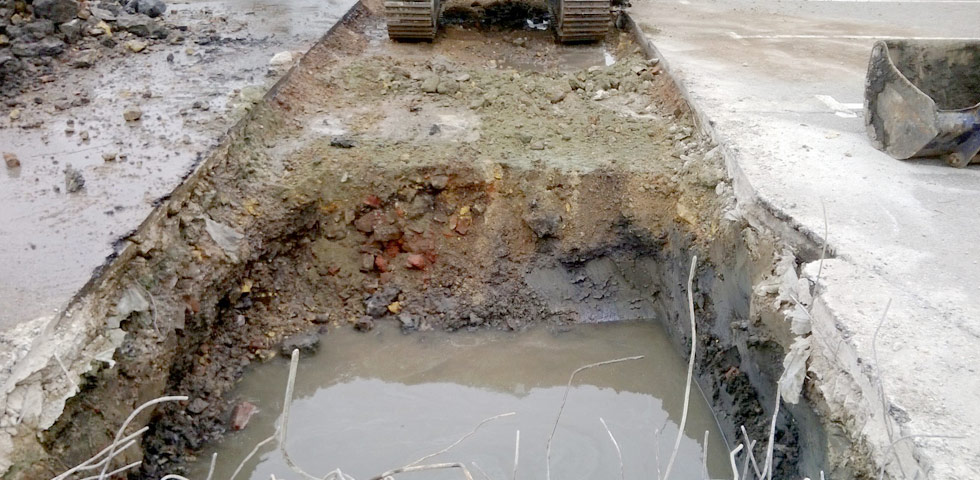
The site was challenging in a number of ways given the presence of contaminated ground, a high water table, reinforced concrete slab, services and constraints with space. Wardell Armstrong Archaeology’s expertise in urban sites of this type enabled the project to proceed effectively. Successful co-ordination of the archaeological fieldwork also ensured that the client was able to obtain the information required in support of their planning application whilst keeping the retail park open for business.
The retail park stayed open for business while the site investigations were undertaken
The evaluation trenching also provided useful information to aid the scoping and execution of archaeological works required at the southern end of the retail park, for a separate planning application by the client, where previous excavations had revealed significant archaeological remains and where contaminated land was also an issue.
Advantages to client
- Negotiation with English Heritage to ensure that information on the archaeological resources within the site were identified and English Heritage were able to make a decision regarding the planning application on a reduced scope of work
- Keeping the retail park open for business while the site investigations were undertaken
- Obtaining useful information for the scoping and execution of archaeological works for a separate planning application at the southern end of the retail park.
Images (above) show:-
- Trench with contaminated water and reinforced concrete slab
- Barking Abbey around 1500 AD
- Evaluation trenching also provided useful information to aid the scoping and execution of archaeological works.