Human remains discovery can halt a development
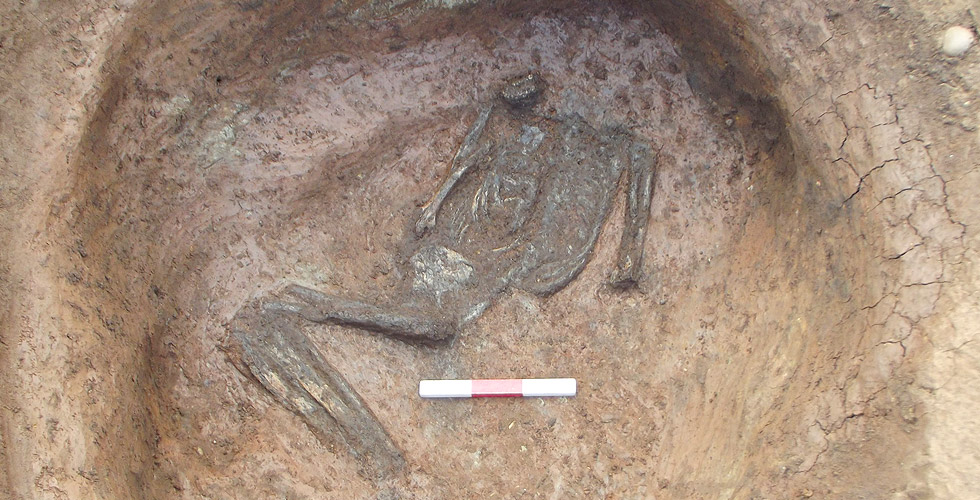
Although the discovery of human remains on an archaeological site can halt development, their treatment must become a priority for the archaeologists and therefore the developers.
The excavation and issues surrounding the remains must be dealt with in a professional and sensitive manner by both parties.
The employment of appropriate procedures and the procurement of the correct legal documents will ensure that their discovery and recovery will be handled cost-effectively and quickly whilst also maintaining respect for the dead.
Thousands of human skeletons are disturbed as a result of development every year.
If human remains are discovered on an archaeological site, archaeologists cannot lift the remains until a burial licence is procured.
Advance burial license
Example: In the case of a small evaluation in Bristol, the base of an Early Bronze Age collared urn and cremated human remains was discovered. Wardell Armstrong Archaeology obtained a burial licence in advance of the project, because research conducted beforehand revealed that human remains had been discovered in close proximity to the site.
Occasionally, the coroner and police will be involved if human remains are discovered on an archaeological site. The coroner does not, however, have to be informed if the remains are interred within a recognised burial ground.
Ethical treatment
Ethical treatment of human remains is a huge issue, particularly with more recent remains of known identity (18th to 20th century), as descendants can be traced. This issue can be particularly sensitive in the public domain; archaeologists and osteoarchaeologists must at all times act professionally and treat the dead with respect.
Further information
Managing human remains risks on development sites »