Exposing external Roman wall foundations - 1.6m and counting!
Time frame: Middle of March 2014
Further updates from the Blackfriars archaeological dig
All Blackfriars site updates »
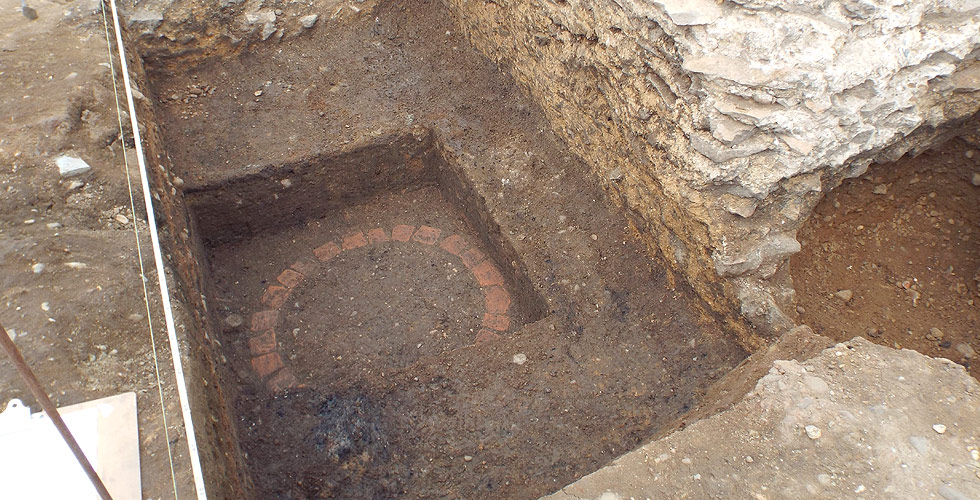
Feature image: An exposed post-medieval well and Roman wall.
Excavation of the internal and external surfaces have continued as well as large amounts of recording. The foundations of the Roman walls have been exposed in the cut of the post- medieval well.
The excavation of this medieval truncation has given further evidence for the consolidation of the ground by the Romans using sand and gravel and other material.
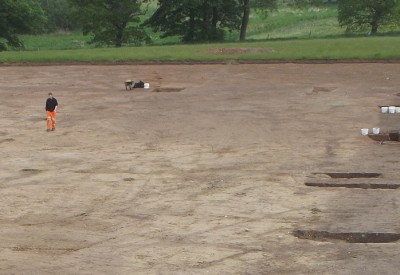
An overview of the Blackfriars archaeological dig - looking south
Recording Roman floor layers with a large pit being shown in the
foreground
Exposing external Roman wall foundations - 1.6m and counting!
Recording the Roman ground consolidation deposits which were cut by
the post-medieval well
Fragments of painted wall plaster (with a brown and white design), a fragment of rotary quern and a Roman tile with hoof prints of a sheep or goat have been recovered.
Painted wall plaster with brown and white design
A fragment of a rotary quern
Querns are stone hand mills used for grinding corn to produce flour but they may have been used to grind other ingredients and materials to produce foods, dyes and medicines.
A Roman tile with a hoof print of a sheep or goat
Proposed high quality student accommodation
Wardell Armstrong Archaeology are working in partnership with developers Watkin Jones, who are enabling the safeguarding and cataloging of all developments and artefacts on the site. When the dig has finished, attention will turn to the proposed development of high quality student accommodation.
Watkin Jones have created well over 25,000 student accommodation units in prime locations at key university sites nationwide since 1999.
Computer generated image of the south elevation of the proposed student
accommodation to Blackfriars Street
Watkin Jones are developing the site for proposed student accommodation. They are ensuring the safeguarding of important artefacts and the gathering of important information about Leicester’s past by funding the excavation. In agreement with the City Archaeologist, regular updates on the progress of the excavation and on the finds which are being recovered are being distributed via:-
The aim is to ensure that information on the excavation is put into the public domain and that the local community, as well as the wider public, have an opportunity to share in this interesting archaeological project.