Focus on the masonry remains of the Roman building
Time frame: Middle of March 2014
Further updates from the Blackfriars archaeological dig in Leicester
All Blackfriars site updates »
Feature image: Painted wall plaster from archaeological dig at Blackfriars, Leicester.
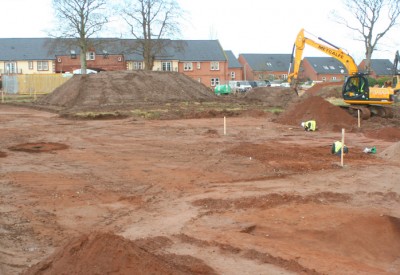
Good progress continues to be made (with the help of the weather!) with the southern and central areas nearing completion.
Work has focused on the masonry remains of the Roman building, attempting to identify the full extent and phasing of the walls and colonnade. Columns from Roman buildings, similar to those that would have been used to form the colonnade on the site, have been raised in the churchyard at St Nicholas.

The foundations of a Roman wall.
Note the presence of a buttress (the masonry perpendicular to the main
wall) which may indicate that this is an external wall. Buttresses
support and add strength to structures.
Buttresses have been identified on the eastern wall indicating that this is an external wall of a sizeable building requiring support. An area of burning in the internal rubble indicates that a hearth or similar feature previously existed but has been removed during later disturbance and robbing.

A surviving Roman wall in the
foreground and the ‘cut’ that is left when the wall has been
robbed out running into the opposite section

A fragment of Roman column base
that has been raised in the churchyard of St Nicholas
Pockets of later medieval and post-medieval archaeology are being investigated to give a window into the Roman archaeology that they cut. Phases of earlier activity have been identified with successive layers of floors and burnt layers, although these appear to be limited in their extent. Evidence for the internal decoration of the building has been found in the form of painted wall plaster and a single tessera (the tile used to create mosaics) have been recovered.

A freshly excavated
fragment of painted wall plaster

A possible fragment of tessera, an
individual tile that could have been used in the creation of a
mosaic.

The orange colour indicates that
some kind of heating has occurred, probably indicating a hearth or
similar feature

A possible fragment of kiln
lining
Proposed high quality student accommodation
Developers Watkin Jones are enabling the safeguarding and cataloging of all developments and artefacts on the site. When the dig has finished, attention will turn to the proposed development of the accommodation.
Watkin Jones have created well over 25,000 student accommodation units in prime locations at key university sites nationwide since 1999.

The proposed south east elevation - to
Blackfriars Street
Watkin Jones who are developing the site for proposed student accommodation, are funding the excavation and in agreement with the City Archaeologist will be sending out regular updates on the progress of the excavation and on the finds which are being recovered via
The aim is to ensure that information on the excavation is put into the public domain and that the local community, as well as the wider public, have an opportunity to share in this interesting archaeological project.