Iron age, medieval and Roman pottery unearthed
Time frame: Mid February 2014
Regular updates from the Blackfriars archaeological dig in Leicester
All Blackfriars site updates »
New information from the Wardell Armstrong Archaeology managed excavation at Blackfriars in Leicester, where Watkin Jones are developing the site for student accommodation.
Watkin Jones have created well over 25,000 student accommodation units in prime locations at key university sites nationwide since 1999.
Images courtesy of Adam Slater.
Feature image: The image at the top of the page shows a medieval green glazed pottery jug handle.

High status Iron Age pottery has been recently discovered at Blackfriars, Leicester
Points of significance
Fine, high status pottery dated to the early 1st century AD (above) has been recovered from the ditch which produced the coin mold confirming this is an Iron Age feature. It appears that we have the corner of an Iron Age enclosure as the ditch turns sharply northwards and runs parallel with the eastern edge of excavation. This ditch is also known to extend west as it matches up with a ditch previously excavated on the other side of the road.

High Status Roman pottery known as Samian Ware complete with makers mark.
The focus for the time being is on the southern area - to ‘clear’ this area, so the main focus can be on the northern end of the site where the archaeology is thicker due to less modern disturbance.
Iron Age, Roman and medieval features
Numerous features have been excavated in the southern area with a mix of Iron Age, Roman and medieval features being identified whilst Roman and medieval features have been cleaned and excavated at the northern end. All are producing artefacts which are identifiable and will allow dating of the site.
High Status Roman pottery known as Samian Ware is shown (above) complete with makers mark. These stamps can identify the workshop in Gaul where the pottery was made - and who the potter was.
More Roman structural remains have been uncovered although no floor surfaces have been identified at this time so these rubble walls may be the foundations of a building whose upper parts have been robbed away.
Cess-filled medieval pits have been identified in the southern and northern ends of the site widening the time span of archaeology on the site.
Battling the weather!
The rain rarely relented during this period, reducing the site to a virtual swamp. Work was nonetheless carried on and significant progress made during these very trying circumstances.

Battling the elements to plan and record the site

Excavating the late Roman and medieval pits

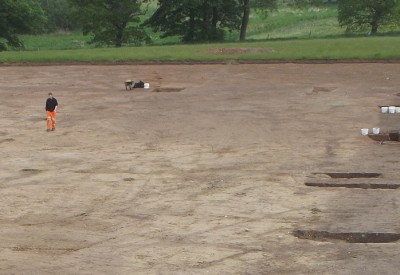
The Blackfriars site overview looking north-west

A welcome break from the weather to check the site plans