The significance of the dig for the City of Leicester
Time frame: Beginning of May 2014
A special report from the Blackfriars archaeological dig
All Blackfriars site updates »
Feature image: Leicester City Archaeologist Chris Wardle on site at Blackfriars.
The ongoing excavations at Blackfriars have been overseen by Chris on behalf of the City Council’s Planning Department. We are fortunate in being able to present an article by Chris who has kindly presented us with:-
- a fascinating insight into the role of the City Archaeologist
- the reasons for the Blackfriars excavation
- and findings of significance.
And this is perhaps an appropriate time to acknowledge our sincere gratitude and thanks on behalf of ourselves and developers Watkin Jones to Chris, the Planning Department and the people of the City of Leicester for the warmth of their welcome and assistance received at Blackfriars.
Over to you Chris…
Background information
I’m the City Archaeologist and work in the City Council’s Planning Department. The Planning Department’s main role is to encourage development in the City. Without development, the City’s economic base will be undermined: there will be fewer jobs, less prosperity, and the City will fall into decline. It is, however, vital that that that development should not degrade the City’s environment. It is also important that development should not be at the cost of the City’s assets without some action being taken to offset that loss. Archaeological remains are assets that hold important information on how Leicester became the city it is today, and, in some cases such as the discovery of Richard III, they may also have the potential to be put on display and attract visitors to the city.
Part of my role as City Archaeologist is to:-
- Identify where development might result in the loss of important archaeological remains and to advise my colleagues the planning officers of this.
- Where I believed this to be the case to be the case, I see that the developer carries out fieldwork that will show either that there are significant archaeological remains on the site, or that there are not. This is a process that archaeologists describe as ‘trial trenching’ or, if you are really into the jargon, ‘a field evaluation’.
- Where the trial trenching has show that important archaeological remains will be lost, I then work with the developers to see if their proposal can be revised to reduce the impact on the archaeological remains. If this is not the case, I then ensure that the remains that are to be lost are excavated to a suitable standard and that the findings of the excavation are published to an appropriate degree.
The reasons for the Blackfriars excavation
The proposed student accommodation at Blackfriars lies within the Roman tribal capital of the East Midlands. So it was always likely that there would be important archaeological remains on the site. Erecting a set of buildings rising to 12 floors is bound to require very dense and deep foundations, which will inevitably result in the total loss of the information contained in the archaeological deposits. To offset that loss, the City Council has required the developer, Watkin Jones, to excavate the deposits that will be lost as a result of the development and to publish the findings of that excavation.
The story of the development of this site is quite complex, with a number of false starts and with the intervention of the crash of the late 2000s. As a result, the site was the subject of trial trenching on two occasions, once in 2007, when the site still had a number of standing structures on it, and again in 2010, when almost all of these structures had been demolished. The two sets of fieldwork demonstrated that the part of the site where the proposed student accommodation is to be built contained important archaeological remains. These remains clearly contained very significant information on Leicester’s Roman and Iron Age past, and would have to be fully recorded by excavation before the development could proceed.
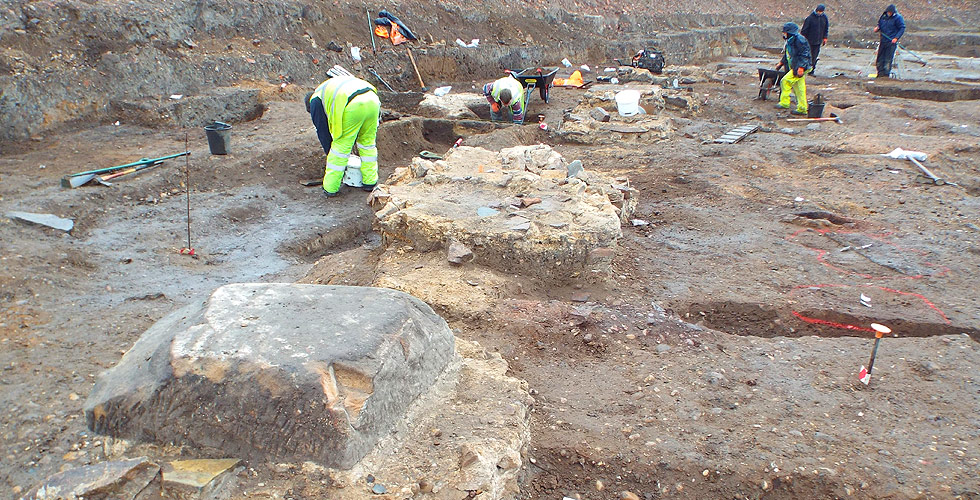
Roman column bases are revealed at the
Blackfriars dig in Leicester
The findings of the excavation
It will take many months before all the evidence recovered is fully examined by teams of specialists and the story of the site is as fully understood as possible. So anything said at this stage is very much a first draft of the story.
One of the more pleasing aspects of the dig has been the discovery of the Roman bricks and tiles bearing the imprint of animal hoofs and paws. These are glimpses of fleeting moments that took place many centuries ago, when animals wandered across the site where the bricks and tiles had been laid-out to dry in the sun. This was after the the bricks has been formed, but before they had been fired in a kiln. Firing the bricks preserved these fleeting moments for the archaeologists to unearth centuries later. Though it has to be understood that the place where the bricks and tiles were laid-out all that time ago may have been tens or hundreds of metres away from the site currently being excavated.
Though as an archaeologist, I am more interested in what went on on this particular site and how it enhances the picture we have of the early development and growth that is beginning to emerge of what went on here.
Iron Age
It had been realised for some time that Leicester began to emerge as as an important tribal centre before the arrival of the legions in the mid-1st century AD. The findings on our site add considerably to this picture. The density of Iron Age related remains - pits (for waste and/or storage), ditches and traces of roundhouses - shows that there was something special about the Iron Age settlement on the east bank of the River Soar in the 1st century BC. The discovery of the high quality imported pottery from Roman occupied Gaul reveals that some person/s who lived on the site (or close by) in the 1st century BC/early 1st century AD, was able to draw in this trade. The discovery of the flat clay-moulds - in which slugs of valuable metal was poured as part of the process of making coins - shows that there was some person/s in the settlement with the authority and status to order coins to be made.

A fragment of Iron Age coin mould
found at Blackfriars in Leicester
Early Roman
The signs of intense activity proceeded into the early Roman period; pits and ditches continued to be dug. The main differences were that:
- some of the pits were much larger and of a different shape (probably quarries)
- roundhouses were replaced by rectangular structures either of timber or of timber framing
- the pottery and personal ornaments became characteristically Roman
- and Roman coinage arrived and the local mint disappeared.
Mid-Late Roman
When the first set of trial trenching took place in 2007, the plinth of a Roman column was unearthed. At the time, I thought this was evidence for an important Roman public building in stone, or else the residence of some grand Roman family. The excavation seems to have revealed something different.
We know from elsewhere in the Roman town that sometime in the early 2nd century, the layout Roman Leicester was revamped, with a regular grid being set out. Some time after this, work started on a large Roman building. But the building never took on its planned form. Something prevented the original grand design from being completed. Whether the money just ran out, or the pits dug by previous generations meant that the original design could not be executed, we don’t know at present. The semi-completed structure continued to stand for many decades, but rather than being put to its intended design, use it was used and adapted for small scale industrial activity.
Dark Ages
After the abandonment and collapse/dismantlement of the stone building, the area seems to have been abandoned and became a space for cultivation and waste disposal.
Mediaeval
The area seems to have continued to be on the margins of the occupied part of the town. There are few traces of structures, but there are many more rubbish pits dating from the Middle Ages than from the Dark Ages. And folk from the rest of the town who wanted stone for their buildings were clearly able to wander down to this part of town to grub-out the stone they desired from the remains of Roman buildings.
My thanks to Watkin Jones, both for providing us with the opportunity to examine the archaeological deposits on the site, and for their professional approach to addressing the requirements of the excavation. My thanks also to Wardell Armstrong Archaeology, both for the skill that they have shown in unearthing and interpreting the archaeological remains, and for the warm welcome they have extended to folk from the City Council and archaeologists visiting the site.
Chris Wardle
City Archaeologist